
Want to know what your cards are worth? Kardexy is free.
Counterfeit Pokémon cards have improved a lot. The obvious fakes with misspelled names and cartoon-blue backs still exist, but the better ones now pass a quick glance, and they’re aimed squarely at the expensive cards.
Most fakes give themselves away on three things: the feel of the card, how it handles light, and the sharpness of small text. None of that requires special equipment.
How can you tell if a Pokémon card is fake? Compare the card’s texture, weight and light transmission against a card you know is genuine. Real cards have an opaque black inner layer, crisp text at small sizes, and a specific stiffness. Fakes usually feel thinner, let more light through, and blur under close inspection.
Start with a card you know is real
Nearly every reliable test is a comparison test. Before checking a suspicious card, pull a common from the same era that you’re confident about.
That matters because Pokémon cards have changed over 30 years. Print quality, gloss, colour saturation and even card thickness differ between a 1999 Base Set card and a 2024 release. Comparing a modern fake against a genuine 1999 card produces confusing results in both directions.
Same era, same language, ideally same set. Then work through the checks below.
The three checks that catch most counterfeits (in short)
Genuine Pokémon cards are manufactured with an opaque black ink layer sandwiched between the front and back faces, and that construction drives the most reliable tests. Hold the card against a bright light: a real card passes very little through and looks solid, while most counterfeits glow, showing the artwork silhouette clearly. Look at the card edge straight on and you should see a thin dark line running through the middle, consistently around the whole card; fakes often show no line or only patches of one. Third, examine the small text, particularly the copyright line along the bottom, which is where counterfeits fail most often because it demands high print resolution. Genuine text stays sharp at small sizes while fakes blur, thicken, or show colour fringing. All three tests are non-destructive, and all three work best compared against a card you already know is genuine from the same era.
The light test
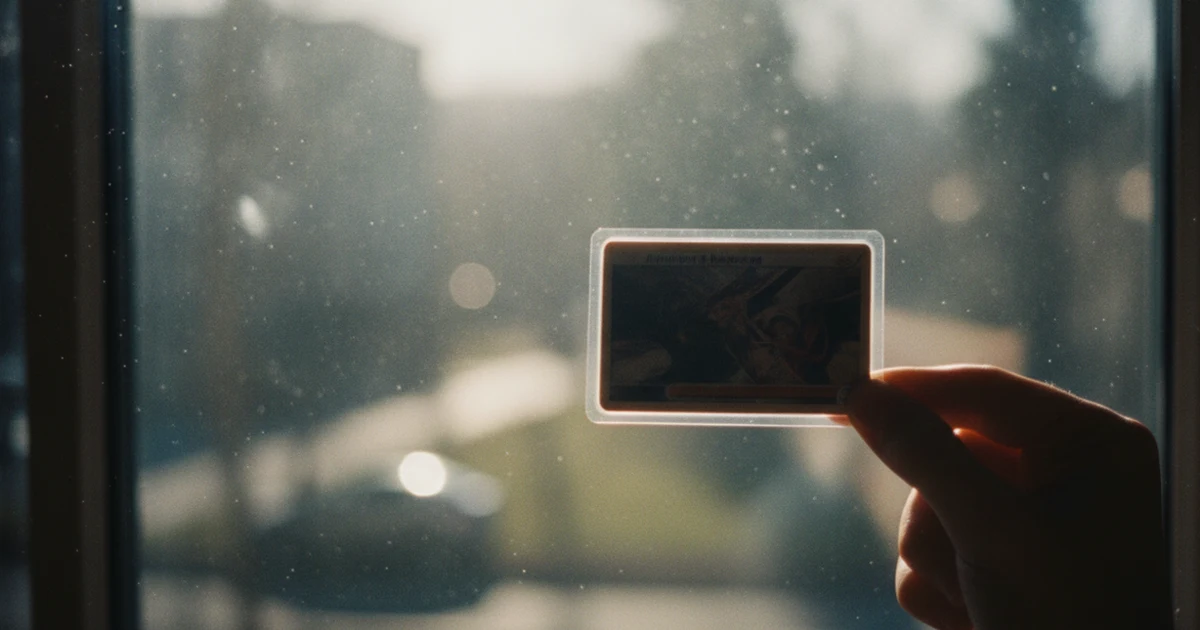
Hold the card up to a bright light, a phone torch works, and look at how much passes through.
Genuine Pokémon cards are built with an opaque layer of black ink sandwiched between the front and back. Very little light gets through. A real card looks solid and dark.
Most counterfeits skip or thin that layer to save cost. They glow. You’ll see the artwork silhouette clearly through the back, or the whole card lights up orange.
This single test catches a large share of fakes, and it costs nothing.
The edge test
Look at the card edge straight on, ideally under decent light.
A genuine card shows a thin dark line running through the middle of the edge: that’s the black core layer. It’s subtle but consistent all the way around.
Counterfeits frequently have no visible dark line, or one that appears in patches. Some fakes are also noticeably thinner or thicker than the real thing, which you’ll feel immediately if you stack the suspect card against five genuine ones and run a thumb down the side.
Be careful with heavily played cards. Worn edges can obscure the line legitimately.
Text sharpness and font
Real Pokémon cards are printed at high resolution, and the small text stays crisp.
Look closely at:
- The attack descriptions and flavour text. Genuine text has clean edges at small sizes. Fakes blur, thicken, or show slight colour fringing.
- The copyright line along the bottom. This is small, dense text and it’s where fakes fail most often.
- HP numbers and energy symbols. Wrong font weight, wrong spacing, or slightly off symbol shapes are common tells.
- Spelling. Still worth checking. Cheap fakes get Pokémon names, attack names and abilities wrong.
A phone camera zoomed in works fine as a magnifier if you don’t have a loupe.
Colour and print quality
Counterfeit cards often run too dark, too blue, or too saturated compared to the genuine version.
Base Set fakes in particular tend to look heavier and bluer than they should. Modern fakes sometimes go the other way and look washed out.
Also check the back of the card. The blue swirl pattern, the Poké Ball, and the yellow border have specific colours and proportions. Lay a suspect card face down next to genuine ones in a row: a wrong back stands out instantly when it’s surrounded by right ones, and it’s much harder to spot in isolation.
The texture and bend test
Genuine cards have a particular finish. Modern cards carry a light gloss with a subtle texture; older ones are flatter.
Fakes often feel too smooth and slippery, or oddly rough.
You can bend a card very slightly to feel its stiffness against a known-genuine one. Real cards have a specific springiness and return flat. Do this carefully, and never on a valuable card. A crease is permanent and it destroys value. If the card is worth enough for the question to matter, use the light and edge tests instead and skip anything physical.
Which cards get faked
Counterfeiters target value, so suspicion should scale with price:
- Base Set holos, especially Charizard, and especially anything with a 1st Edition stamp
- Alternate art and full art cards from recent popular sets
- Gold and rainbow secret rares
- Promos with limited distribution
- Complete “1st Edition Base Set” lots sold cheaply online, which are almost always reprints or fakes
A 1st Edition stamp on its own proves nothing. It’s one of the most commonly faked elements precisely because it adds so much value.
A bulk common is rarely worth faking. If someone’s selling a $2 card, counterfeiting it makes no economic sense.
Where fakes usually come from
Most counterfeits reach collectors through large online marketplaces with many small sellers, cheap bulk lots, and social media sales.
Warning signs on a listing: a price well below market with no explanation, stock photos rather than pictures of the actual card, a seller with no history, or a “1st Edition Base Set” bundle for the price of a sandwich.
Buying from established card shops and dedicated TCG marketplaces reduces the risk considerably, though it never eliminates it.
Proxies and reprints aren’t the same as fakes
Worth separating, because people use “fake” for three different things.
Counterfeits are made to deceive. Someone is trying to sell you a $400 card for $400 when it’s worth nothing.
Proxies are stand-ins players make for casual games, often clearly marked and never intended to fool anyone. They have no collectible value and aren’t hiding it.
Official reprints are entirely genuine cards. The Pokémon Company has reprinted popular cards many times across celebration sets and special collections. A reprinted Charizard is a real Pokémon card, printed by the rights holder, and it’s worth a fraction of the original printing.
That third category causes the most confusion. Someone finds a Charizard, looks up the famous price, and can’t understand why nobody will pay it. The card is real. It’s just a different printing, and the printing is most of the value.
Identifying the exact set and card number sorts this out immediately, and it’s a much more common problem than encountering an actual counterfeit.
How Kardexy helps
Kardexy scans a card and identifies the exact printing, then shows the live market price from TCGplayer in dollars and Cardmarket in euros, adjusted for condition.
That’s useful as a sanity check on price. If a seller wants $40 for something trading at $400, or $400 for something trading at $12, the number tells you to slow down and look harder. Price mismatches are one of the more reliable signals that something is off.
Being straight about the limits: Kardexy is a scanner and price tool, not an authentication service. It reads the card and prices the printing. It can’t verify that the physical object in your hand is genuine, and no photo-based tool honestly can. Authentication needs the card in hand, and for high-value cards that means a grading company like PSA, BGS or CGC, which Kardexy is not.
Use the price as a flag, then use the light, edge and text checks on the card itself.
Free to start on iOS and Android, or check a card in your browser with the card identifier.
Frequently asked questions
What do counterfeit Pokémon cards look like? Usually slightly off rather than obviously wrong. Common signs are a card that lets light through, blurry small text, colours that run too dark or too blue, a missing dark line at the card edge, and a texture that feels too smooth.
Is there an app to spot fake Pokémon cards? No app can authenticate a card from a photo. Scanning apps identify the card and its market price, which flags suspicious pricing, but confirming a physical card is genuine requires handling it or sending it to a grading company.
What are the most faked Pokémon cards? Base Set Charizard, 1st Edition stamped cards, modern alternate arts, and gold or rainbow secret rares. Counterfeiters follow value, so the more a card is worth, the more carefully it deserves checking.
Does the light test always work? It catches a large share of fakes, since most skip the opaque black inner layer. Better counterfeits include one, so a card passing the light test still deserves the text, edge and colour checks.
Can a fake card have a 1st Edition stamp? Yes, and many do. The stamp adds so much value that it’s a primary target for counterfeiters. Check its print sharpness and placement against a genuine card from the same set.
The short version
Compare against a known-genuine card from the same era. Check light transmission, the dark line at the edge, and the sharpness of the copyright text. Those three catch most fakes without touching the card in any way that could damage it.
If the price doesn’t match the market, treat that as a reason to look harder. Scan the card with Kardexy to see what the printing actually trades for, and how to tell if a Pokémon card is 1st Edition covers the stamp that fakes copy most often. For the wider question of which cards are worth checking at all, see what Pokémon cards are worth money.